
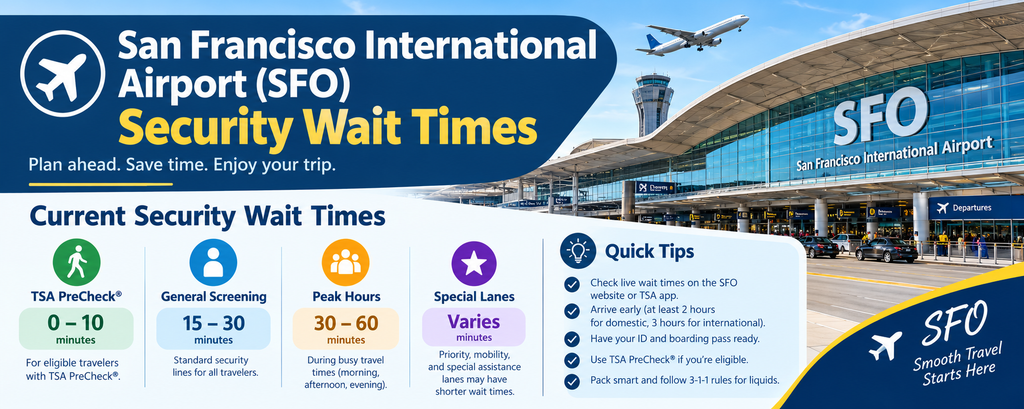
The security lines at San Francisco International Airport (SFO) typically take about 15-30 minutes to navigate, with peak times taking up to 40-50 minutes. TSA PreCheck reduces it to under 10 minutes. The best times to go through SFO security lines are in the early morning (before 6 AM) and late evenings (after 8 PM). As the busiest air travel gate to the Bay Area, San Francisco International Airport handles many tens of millions of passengers each year, with four passenger terminals. Have you ever been stuck in one of those endless SFO security lines while trying to board your flight? Telling people just to arrive at the airport two hours early isn’t quite specific enough. This guide will tell you everything you need to know about SFO security wait times.
What Are the Actual Security Wait Times at SFO?
The security screening at SFO is considered to be among the most efficient in the United States. Here are the typical security wait times by the time of day according to multiple wait time trackers and travel websites.
| Time of day | Average wait (standard lane) | Average wait (TSA PreCheck) |
|---|---|---|
| Early morning (4-6 AM) | 10-15 minutes | Less than 5 minutes |
| Morning rush (7-9 AM) | 30-45 minutes | 5-10 minutes |
| Midday (10 AM-2 PM) | 15-25 minutes | Less than 10 minutes |
| Afternoon/evening rush (3-6 PM) | 30-50 minutes | 10-15 minutes |
| Evening (8 PM+ ) | 10-15 minutes | Less than 5 minutes |
These figures are rough estimates calculated from aggregated TSA checkpoint waiting times and passenger experiences, not a current guarantee – depending on the date, wait times can vary according to the staffing at the airport, schedule of flights, and number of checkpoints available. According to a popular 2024 study based on Customs and Border Protection data, national average TSA waiting times are below 27 minutes, and SFO generally performs at or above that mark on an ordinary day.
SFO Terminal Layout and Checkpoints
SFO has four terminals: Harvey Milk Terminal 1, Terminal 2, Terminal 3, and International Terminal (Boarding Areas A and G). Terminals are connected through walkways and AirTrain service. For the most part, each terminal has its own checkpoint, and if you have a same-day boarding pass at SFO, you may choose any checkpoint in the airport, even if it is far from your departure terminal. This can be useful when there is a long line at your own checkpoint; by going somewhere else, you might save some time.
| Terminal | Airlines (Examples) | Checkpoint Information |
|---|---|---|
| Terminal 1 (Harvey Milk) | Alaska, American, Delta, JetBlue, Southwest | Single concourse, one main checkpoint |
| Terminal 2 | Air Canada, Breeze | Two checkpoints, located at Gates C and D |
| Terminal 3 | United | Checkpoint near Gate E1; currently under renovation |
| International Terminal | United, Lufthansa, Emirates, Cathay Pacific, ANA, and more | Two checkpoints at Boarding Areas A and G; thorough document verification for international departures |
Since Terminal 3 is currently being renovated (this ongoing construction will modernize the check-in and security facilities), travelers flying United flights are expected to allocate some extra buffer time while traveling.
What Really Influences Wait Time at SFO?
Several factors really affect SFO’s wait times for screenings:
- Hour of the day. Departure times in the morning (approximately between 6 and 9 AM) and late afternoon (between 3 and 6 PM) generate the largest number of people in the queues due to the high volume of departures during these periods.
- Day of the week. Sundays and Fridays usually have higher traffic than other days of the week due to weekend trips.
- Season and holidays. The week before Thanksgiving, Christmas holidays, and spring breaks are usually SFO’s peak seasons, during which one might experience up to 45-minute waits even in terminals with numerous PreCheck passengers.
- Security staff. SFO contracts its screening procedures to a private security company (Covenant Aviation Security); thus, staffing changes might occur on an hourly and by-terminal basis.
- International and domestic departure gates. International departure lines, especially at A and G checkpoints at the International Terminal, require a higher level of document verification and, therefore, longer waiting times.
Programs That Will Save You Time
If you travel frequently through SFO, your most powerful tool will be the expedited screening program options:
- TSA PreCheck provides you with access to the exclusive lane where you are allowed to keep your shoes, belt, and light jacket on, and you can leave your laptop and permitted liquids in your carry-on luggage. The process of enrollment involves a multi-year membership payment and is available in all SFO checkpoints except for Checkpoint F3 in Terminal 3, which does not offer PreCheck lanes now.
- CLEAR Plus uses biometric identification (iris scan or fingerprint identification) to bring you to the head of the physical security queue and is available in all SFO checkpoints; however, working hours vary from checkpoint to checkpoint.
- Global Entry is designed specifically for international travelers who pass through the Customs process, and not for the security process itself, but it offers TSA PreCheck services for the members.
- Mobile Passport Control is a free alternative to expedite the customs process using the mobile application.
Using CLEAR and TSA PreCheck in conjunction will ensure that you have the most effective route through SFO.
How Far in Advance Should You Be at SFO?
For a start:
- Domestic flights: Check in 2 hours before departure.
- International flights: Check in 3 hours before departure, especially when traveling from the International Terminal, which takes longer than others to go through the security checkpoint.
- Peak travel periods (weekends, holidays, Sunday morning and Friday evening): Add 30-45 minutes to the first two estimates.
- Passengers with TSA PreCheck/CLEAR membership traveling domestically at non-peak periods: 90 minutes may suffice, although 2 hours is safer and more reliable.
Conclusion
The security lines of SFO Airport appear to be among the fastest of all major U.S. hub airports, ranging from 15 to 30 minutes on average days; however, the fastest lines may be expected to operate during early morning and late evening periods. The line starts being a problem when flying during predictable windows of high volume – weekday morning and evening rush hours, Sundays in the morning, and major holidays. Thus, the safest strategy would be a combination of proper timing (when possible, fly outside peak hours), good preparations (make sure that you know the estimated security wait time and checkpoint hours of your terminal before leaving your house), and if you fly often, membership in TSA PreCheck or CLEAR. While none of these methods can guarantee you a definite wait time (it remains an estimate rather than a promise), combined, these tools may give you full control over one of the most unpredictable elements of your trip through SFO.
Frequently Asked Questions
According to various data sources, the average security wait time for all passengers at SFO is estimated at 15-30 minutes, while the average wait time in TSA PreCheck lanes is less than 10 minutes. However, wait times can reach 40-50 minutes during peak travel hours or holidays.
In terms of wait time, the best times for passing through SFO checkpoints are early mornings (before 6 AM) and late evenings (after 8 PM). On the contrary, the worst checkpoint windows are 7-9 AM and 3-6 PM on weekdays and Sunday mornings.
Two hours before your domestic flight and three hours before your international flight would be sufficient. Extra time might be added in case of holidays and peak times when you check in your luggage.
Almost all SFO checkpoints accept TSA PreCheck except for Checkpoint F3 in Terminal 3. It is necessary to check your checkpoint beforehand since your departure area determines the checkpoint you go through.
The majority of standard lane travelers do not have to remove their shoes at SFO security anymore due to the introduction of advanced screening technology. You can be required to remove your shoes if you set off any alarms while going through the scanners.